01Three kinds of discount
Everything on the Offers screen is one of two things: a promotion, which discounts what is already on your menu, or a combo, which bundles items into a new one. Promotions come in three flavours.
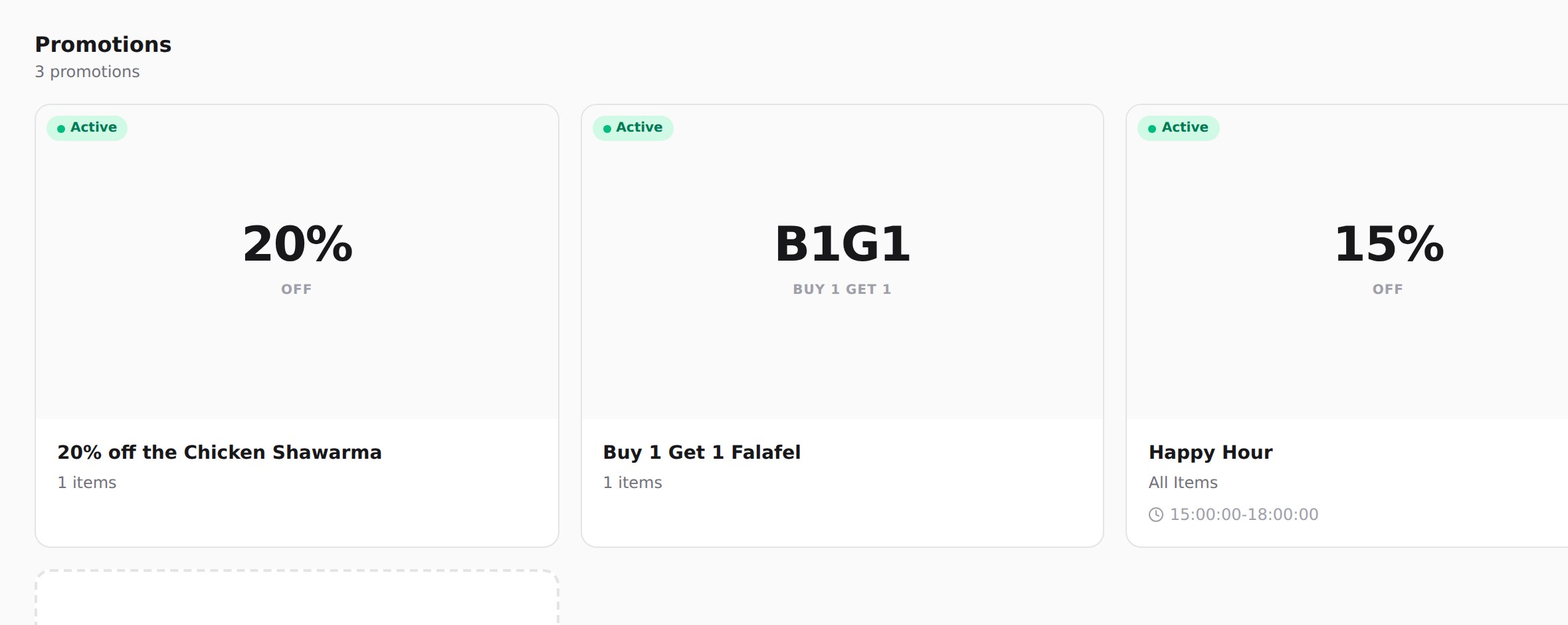
- Percentage off
- Takes a share off the price — 20% off a 3.50 wrap makes it 2.80. The best choice for most offers, and the only type that competes on size (see step 03).
- Fixed amount off
- Takes a set sum off the price, never below zero. Read the warning in step 03 before you rely on one.
- Buy one get one
- Every second item is free. It does not change the price on the menu card — it adds a badge, and the saving appears in the basket.
02Choose what it covers
Every promotion covers one of three scopes. This is the setting that decides who gets the discount, and the one worth being deliberate about.
- All items
- Your whole menu. Simple, and the right shape for a happy hour.
- Specific items
- Only the dishes you tick. Best for pushing one product.
- Specific categories
- Everything in the categories you tick — including items you add to those categories later.
A category-scoped promotion automatically covers new dishes you add to that category. An item-scoped one does not — you have to tick each new dish yourself. If you add products often, category scope is the one that keeps working.
03When two offers collide
This is the part that surprises people. Promotions never stack: when more than one covers the same dish, exactly one wins and the customer gets that single discount.
The order of precedence
Buy one get one beats everything else, whatever the other discount is worth.
Percentage off comes next, and among several the biggest percentage wins.
Fixed amount off comes last.
A fixed-amount promotion only reaches the customer when it is the only offer covering that dish. Put 2 off a wrap alongside a menu-wide 5% happy hour and the 5% wins — even though it saves the customer far less.
If a fixed-amount offer is not showing, this is almost always why. Narrow the other promotion's scope so the two stop overlapping, or express your offer as a percentage.
04Happy hours & date ranges
A promotion can run forever, between two dates, or only on chosen days between chosen hours. Combine them and a promotion runs only when every condition is true at once.
- Start and end date
- A campaign window. The end date is inclusive — a promotion ending on the 30th runs through the whole of the 30th.
- Days of the week
- Weekend-only offers, or a quiet-Tuesday push.
- Start and end time
- The happy-hour window. Pair it with days to get “15:00–18:00, Sunday to Thursday”.
The time window is checked against the customer's own device, not your restaurant's timezone. For local diners the two are the same. A customer browsing your menu from another country sees the offer at their local time, which can be hours out from yours.
05Combos
A combo is not a discount — it is a new product that bundles items at one price, and it shows customers what they are saving.
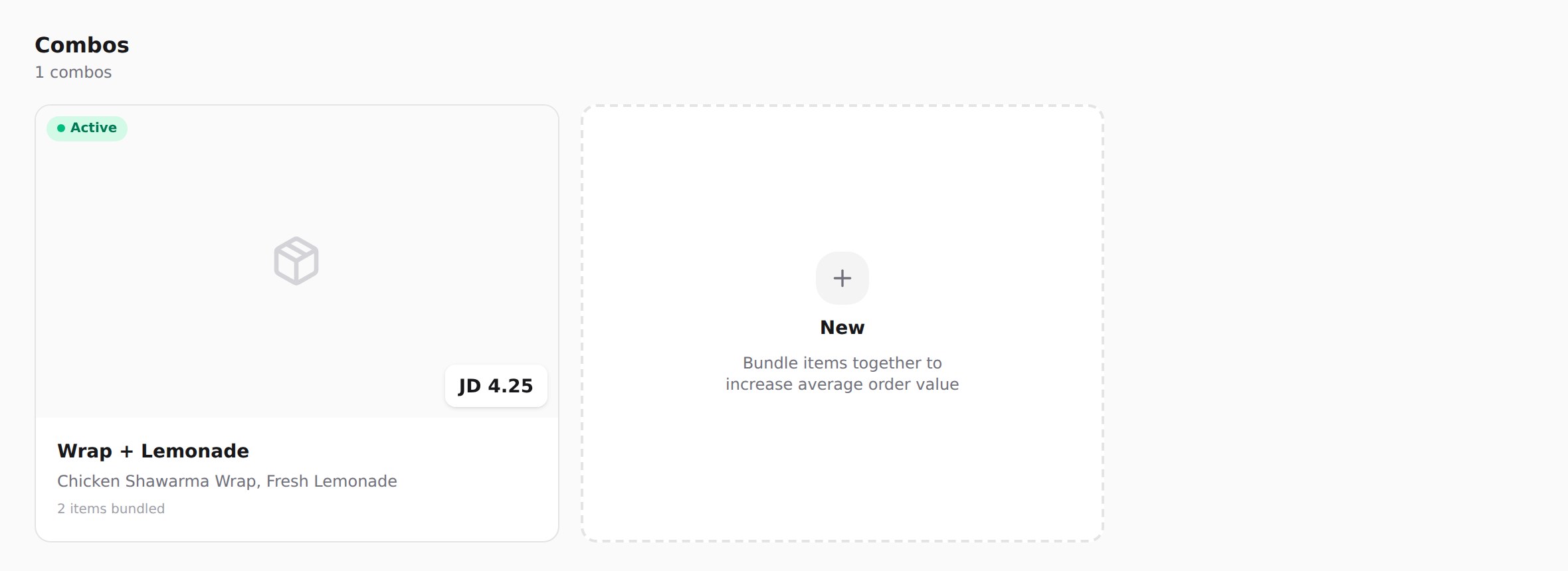
Set the bundle price and, optionally, the original total. Fill the original in and customers see it struck through next to the new price — the saving does the selling for you. Combos take their own start and end dates, so a weekend bundle can expire on its own.
06What your customer sees
The same menu, with two of the promotions above running.
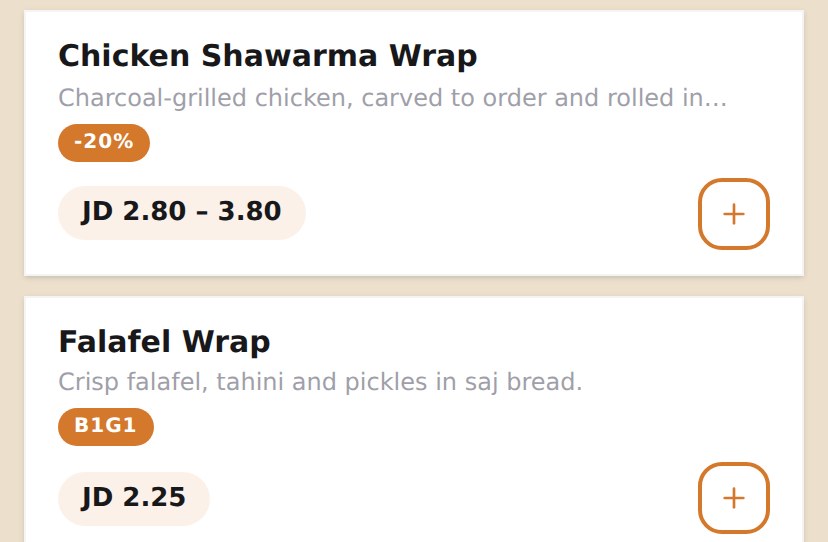
A banner at the top of the menu counts what is running, so customers know to look. Only promotions that are active right now are counted — a happy hour outside its window is invisible to them and does not appear.
07Mistakes to avoid
What goes wrong most often.
- Expecting two offers to add upA 10% promotion and a 20% promotion on the same dish do not make 30% — the customer gets 20%, and nothing tells you the other one was ignored.Fix: plan overlaps deliberately, and treat every offer as “the only one that will apply”.
- Using a fixed amount where a percentage overlapsThe fixed amount silently loses, however much bigger it is. This is the single most common “my discount isn't working” report.Fix: convert it to a percentage, or stop the two scopes overlapping.
- A menu-wide happy hour on top of item offersIt overrides every fixed-amount offer you have, and beats any smaller percentage — quietly flattening a carefully-built set of promotions.Fix: scope the happy hour to the categories you actually want to discount.
- Setting an end date and forgetting itThe promotion vanishes with no warning and no notification. Sales drop and nothing on the dashboard explains why.Fix: check the Offers screen when takings dip — an expired promotion stops showing as active.
- Pricing a combo above its partsCustomers add the items separately, and the struck-through original makes the bundle look like a worse deal than it is.Fix: keep the bundle price genuinely below the sum, and set the original honestly.
08Quick answers
What happens if two promotions apply to the same item?
Only one ever applies — the customer never gets both stacked. Buy-one-get-one beats any percentage discount, and a percentage discount beats a fixed-amount one. Among percentages the biggest wins.
Why is my fixed-amount discount not showing?
A fixed-amount promotion only applies when it is the only offer covering that item. If a percentage or buy-one-get-one promotion also covers it, that one wins instead. Narrow the other promotion's scope, or use a percentage.
How does buy-one-get-one price an odd quantity?
Every second item is free, and odd quantities round in the customer's favour for the paid count: 2 items are charged as 1, 3 as 2, 4 as 2.
Why does my buy-one-get-one item still show the full price?
That is expected. Buy-one-get-one does not change the price shown on the menu card — it carries a badge instead, and the saving appears in the basket once a second item is added.
What timezone do happy hours run in?
The customer's own device clock, not the restaurant's. For local diners that is the same thing, but a customer browsing from another country sees the offer at their local time.
How is a combo different from a promotion?
A promotion discounts items already on your menu. A combo is a separate product that bundles several items at one price, shown with the original total struck through.